
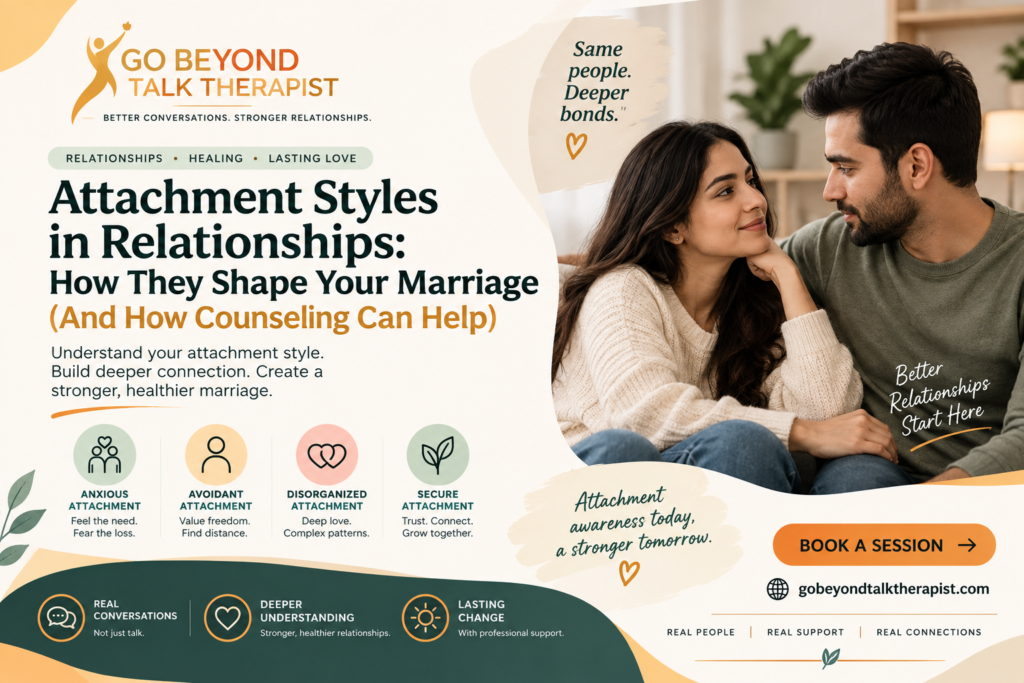
If your feed has been full of talk about “anxious attachment” or someone being a “dismissive avoidant,” you’re not imagining it — attachment theory has become one of the most talked-about relationship concepts in recent years. But behind the trending language is a genuinely useful framework: understanding your attachment style, and your partner’s, can explain a surprising number of the recurring conflicts and disconnects in a marriage. This guide breaks down what Attachment styles in relationships actually mean, how they show up in day-to-day married life, and how couples counseling helps partners build a more secure connection.
What Are Attachment Styles in Relationships?
Attachment styles describe the patterns we develop, often early in life, for how we seek closeness, handle conflict, and respond to distance in our closest relationships. They aren’t fixed labels — they’re tendencies that show up more strongly under stress.
Secure Attachment
Securely attached partners tend to communicate needs directly, tolerate normal relationship ups and downs without panic, and offer and accept comfort easily. Security isn’t the absence of insecurity — it’s the ability to recover from it.
Anxious Attachment
An anxious attachment style often shows up as a heightened sensitivity to distance — a delayed text or a quiet evening can trigger real fear of disconnection, leading to reassurance-seeking that can feel overwhelming to a partner.
Avoidant Attachment
Avoidant attachment tends to show up as discomfort with too much closeness or emotional intensity, often leading a partner to withdraw, shut down, or need distance exactly when their partner is seeking connection.
Disorganized Attachment
Disorganized attachment can involve a push-pull pattern — wanting closeness and fearing it at the same time — which can feel confusing both to experience and to be on the receiving end of.
How Attachment Styles Show Up in Marriage
In marriage, attachment patterns often surface most clearly during conflict. An anxious partner may pursue harder when they sense distance, while an avoidant partner may withdraw further in response — each behavior confirming the other’s deepest fear.
The Anxious-Avoidant Cycle
This is one of the most common patterns couples therapists see: the more one partner pursues, the more the other retreats, which only intensifies the pursuit. Left unaddressed, this cycle can repeat for years, with both partners feeling misunderstood and increasingly disconnected.
Can Attachment Styles Change?
Yes. Attachment styles are shaped by experience, which means they can also be reshaped by new, consistent experiences — including the kind of secure, attuned connection built in couples counseling. This is often referred to as developing “earned security.”
How Couples Counseling Helps You Build a More Secure Bond
A skilled couples therapist near me can help you and your partner recognize your individual attachment patterns, understand the cycle you tend to fall into together, and practice new ways of responding that build safety instead of reinforcing old fears.
Emotionally Focused Therapy and Attachment
Emotionally focused therapy is built directly on attachment theory, helping couples identify the vulnerable emotions underneath their conflict — the fear of not mattering, of being too much, or of being left — and respond to those emotions directly instead of getting stuck in surface-level arguments.
Signs Your Attachment Style Might Be Affecting Your Marriage
Common signs include feeling panicked by normal distance, shutting down during emotional conversations, struggling to ask for what you need directly, or noticing the same pursue-withdraw pattern showing up in every disagreement.
Working With a Couples Therapist Near You
If attachment patterns feel like they’re running the show in your marriage, working with a couples therapist near you can help you understand what’s happening beneath the surface and build the tools to respond differently — together.
FAQS
The four commonly discussed attachment styles are secure, anxious, avoidant, and disorganized (sometimes called fearful-avoidant), each describing a different pattern for handling closeness and distance in relationships.
Yes. Many couples have different attachment styles and build strong, secure relationships — especially with awareness of their patterns and support from marriage counseling when needed.
Many people get a general sense of their attachment style through self-reflection or an informal assessment, though a couples therapist can help you explore it in more depth within the context of your specific relationship.
Emotionally focused therapy is a specific, research-backed approach within couples counseling that focuses on attachment and emotional bonding, rather than one general term for all couples therapy.
It varies by couple, but many partners notice meaningful shifts in how they communicate and reconnect within a few months of consistent work with a couples therapist.
Ready to Strengthen Your Relationship?
Whether you’re preparing for marriage, working through a rough patch, or want support navigating things on your own, you don’t have to do it alone. Schedule your confidential consultation today.
Schedule your consultation: https://gobeyondtalktherapist.com/contact/
Learn more about our services: https://gobeyondtalktherapist.com/services/