
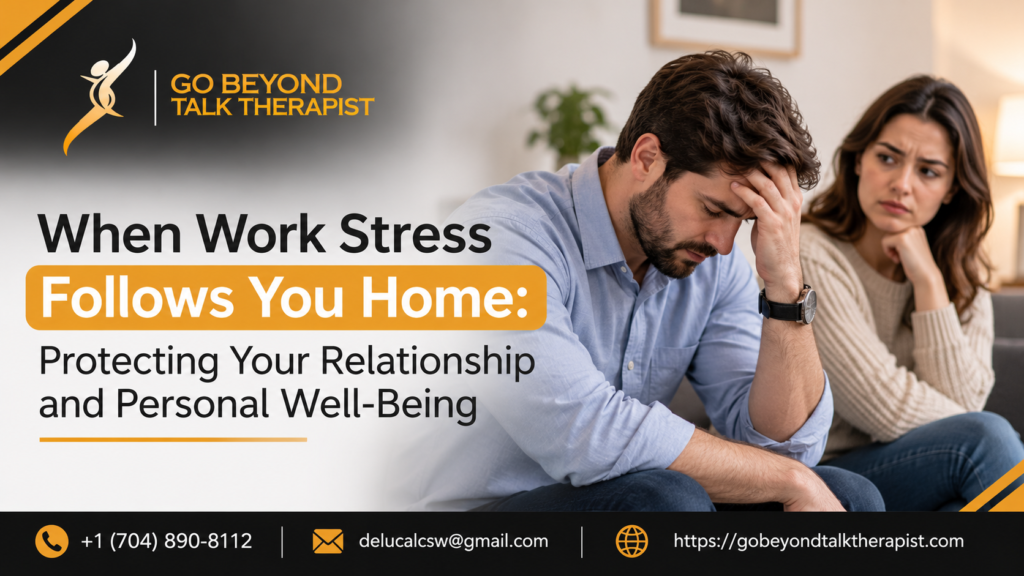
When the Workday Ends but the Stress Does Not
You may leave your workplace at the end of the day, but that does not always mean the pressure stays behind.
A difficult meeting, an exhausting workload, conflict with a colleague, financial pressure, or uncertainty about your job can continue occupying your thoughts long after you get home.
You may become quieter, impatient, distracted, or less interested in conversation. Your partner may notice that you seem unavailable or easily irritated. A simple question about dinner, household responsibilities, or family plans may suddenly turn into an argument.
Over time, work stress can begin affecting emotional intimacy, communication, and the overall atmosphere at home.
Work stress affecting relationships is not simply a matter of having a busy job. It can involve how stress changes the way people communicate, respond emotionally, and participate in family life.
Whether you live in Midland, Monroe, Concord, Indian Trail, or Mint Hill, understanding this connection can help you recognize unhealthy patterns and consider practical ways to manage them.
How Does Work Stress Affect a Marriage?
Stress can influence emotional responses, concentration, patience, and energy.
When someone is under pressure, they may have less capacity to listen carefully or respond calmly. This can make ordinary relationship conversations more difficult.
1. Reduced Emotional Availability
A person dealing with work pressure may spend much of their attention thinking about unfinished tasks, deadlines, or problems.
Even when physically present at home, they may struggle to focus on their partner.
The other spouse may interpret this as disinterest or rejection, particularly if meaningful conversations and shared activities become less frequent.
2. Irritability and Short Temper
Stress can make everyday frustrations feel more difficult to manage.
A minor household disagreement may trigger a stronger reaction than expected. Partners may begin avoiding conversations because they are unsure how the other person will respond.
Recognizing the connection between stress and emotional reactions is important, but it does not excuse hurtful behavior. Each person remains responsible for how they treat others.
3. Less Time for Connection
Long working hours, overtime, commuting, and responsibilities outside work can reduce the time couples spend together.
When free time becomes limited, conversations may focus only on practical tasks.
Without intentional effort, partners may gradually lose the habit of checking in emotionally.
4. Difficulty Separating Work and Home
Some people continue checking emails, answering calls, or mentally reviewing work problems during family time.
This can make it difficult to relax or participate in activities with a spouse or children.
Creating boundaries around work communication may help protect personal time where practical.
5. Financial Anxiety and Relationship Conflict
Job insecurity, changes in income, career uncertainty, or pressure to provide for a household can affect both partners.
One person may become anxious about spending, while the other may feel frustrated by the lack of time or attention.
Financial stress can also make existing disagreements feel more serious.
Why Do Some People Bring Work Stress Home?
Unresolved Workplace Problems
A difficult situation may remain mentally active because the person has not found a solution.
They may repeatedly think about what happened, what they should have said, or what could happen next.
High Workload and Limited Recovery Time
When there is little opportunity to rest between work responsibilities and home life, stress may accumulate.
The person may feel constantly occupied, leaving little energy for meaningful conversation.
Pressure to Meet Expectations
Some people feel responsible for performing well, supporting their household, or meeting professional expectations.
When they believe they are falling short, frustration and self-criticism may affect their mood at home.
Lack of Healthy Stress-Management Habits
Without ways to decompress, people may rely on withdrawal, irritability, excessive screen time, or avoidance.
These responses may provide temporary relief but can create distance in a relationship.
Signs Work Stress Is Affecting Your Relationship
Look for patterns that continue over time:
- You regularly feel distracted during conversations with your spouse.
- Small household disagreements become intense arguments.
- You avoid discussing work because it makes you frustrated.
- Your partner says you are emotionally unavailable.
- You spend most evenings thinking about work.
- You have little energy for shared activities.
- You become impatient with family members.
- You struggle to relax even on days off.
These signs do not establish a diagnosis. They can indicate that stress deserves more attention.
How to Stop Bringing Work Stress Into Your Home
1. Create a Transition Between Work and Home
Give yourself a short period to shift out of work mode.
Depending on your routine, this might include a walk, listening to music, changing clothes, or taking a few quiet minutes before beginning household responsibilities.
The goal is not to ignore work problems. It is to create a boundary between professional demands and personal time.
2. Communicate That You Are Stressed
Your partner may not know why you are quiet or irritable.
Instead of withdrawing without explanation, try saying:
“I had a difficult day, and I need a little time to settle down. I do want to spend time with you once I have had a chance to decompress.”
This gives your partner useful information without making them responsible for solving your work problems.
3. Listen When Your Partner Shares Concerns
If your spouse says that work stress is affecting the relationship, try not to dismiss the concern immediately.
Ask what they have noticed and how it has affected them.
You may discover that they are not asking you to stop working hard. They may simply want more predictable time, better communication, or greater emotional availability.
4. Establish Work Boundaries
Where your job allows, decide when work messages and tasks should stop.
Possible boundaries include:
- Avoiding non-urgent work messages during shared meals.
- Setting a reasonable time to stop checking email.
- Discussing expectations about overtime.
- Protecting planned family or personal time.
- Keeping work conversations from taking over every evening.
Some jobs require emergency availability or irregular schedules. In those situations, discuss realistic boundaries rather than expecting an arrangement that is impossible to maintain.
5. Make Time for Your Relationship
Connection does not always require a major activity.
A short conversation, shared meal, walk, or planned time without screens can help couples reconnect.
Try to make these moments consistent rather than waiting for a completely stress-free week.
6. Address the Source of Stress Where Possible
Consider whether the pressure comes from workload, workplace conflict, unclear expectations, financial concerns, or career dissatisfaction.
Some issues may require a conversation with a manager, changes in work habits, practical planning, or professional advice.
Relationship communication is important, but it cannot solve every workplace problem.
7. Learn to Recognize Your Stress Responses
Pay attention to what happens when pressure increases.
Do you withdraw? Become defensive? Raise your voice? Stop communicating? Work longer hours?
Recognizing these patterns can help you identify when to pause before responding.
If stress is significantly affecting sleep, mood, daily functioning, or well-being, consider discussing it with an appropriate health professional.
How Can Couples Support Each Other During a Stressful Work Period?
Supporting a stressed partner does not mean accepting disrespect or ignoring your own needs.
A balanced approach may include:
Ask what kind of support is needed. Some people want to talk, while others need quiet time first.
Avoid assuming the worst. A quiet evening may reflect stress rather than a lack of care, although repeated emotional withdrawal should still be discussed.
Share responsibilities realistically. If one partner has an unusually demanding work period, discuss temporary household adjustments without allowing the arrangement to become an unspoken permanent expectation.
Maintain boundaries. Both partners should have time to rest and pursue their own needs.
Discuss problems when calm. Difficult conversations are often more productive when neither person is overwhelmed.
When Should You Consider Professional Support?
Work stress may become difficult to manage when it repeatedly affects relationships, emotional well-being, or daily functioning.
Consider seeking support when:
- Work-related pressure causes frequent conflict at home.
- You feel unable to relax outside working hours.
- Your relationship is experiencing ongoing emotional distance.
- Communication has become defensive or hostile.
- You struggle to manage anger or frustration.
- Stress is affecting sleep or everyday functioning.
- You feel overwhelmed by work and personal responsibilities.
Individual counseling may help someone explore stress responses, personal concerns, and coping strategies.
Relationship counseling may help couples understand how work pressure affects their communication and identify healthier ways to handle the resulting conflict.
The appropriate type of support depends on the concerns involved.
Stress Management and Relationship Counseling in Midland, NC
Go Beyond Talk Therapist is based in Midland, North Carolina, and identifies Monroe, Concord, Indian Trail, and Mint Hill as additional service areas.
If work pressure is affecting your relationship, you can explore Stress Management Therapy and Marriage Counseling.
For relationship concerns involving communication and recurring disagreements, you can also review Couples and Relationship Counseling.
If you are looking for therapy or relationship support in Midland, Monroe, Concord, Indian Trail, or Mint Hill, contact the practice to confirm which services and appointment options are currently available.
Frequently Asked Questions
1. Can work stress ruin a marriage?
Work stress does not automatically ruin a marriage, but ongoing pressure can affect communication, emotional availability, intimacy, and conflict. Addressing the stress and its effect on the relationship can help.
2. Why am I irritated with my spouse after work?
Work pressure, mental fatigue, unresolved workplace concerns, and limited recovery time may affect patience. It is useful to recognize the pattern and communicate your need for time to decompress.
3. How can I stop bringing work stress home?
Create a transition routine, establish realistic work boundaries, communicate with your partner, and identify the workplace issues contributing to the pressure.
4. How can I support a partner who is stressed about work?
Ask what support they need, listen without immediately judging, discuss household responsibilities, and maintain healthy boundaries for both people.
5. Should couples discuss work problems every day?
There is no single rule. Some couples appreciate regular conversations, while others prefer to limit work discussions during personal time. Discuss what feels helpful to both partners.
6. Can counseling help with work-related stress?
Individual counseling may help someone explore stress and coping habits. Couples counseling may help address communication and relationship difficulties connected to work pressure.
7. When does work stress become a serious concern?
Consider professional support when stress consistently affects sleep, mood, relationships, or everyday functioning, or when you feel unable to manage it independently.
8. Where can I find stress management therapy near Midland, NC?
You can contact Go Beyond Talk Therapist in Midland, NC, to ask about current stress-management services and availability for nearby communities.
Protect Your Well-Being and Your Relationship
Work may be an important part of your life, but it should not have to occupy every moment outside the workplace.
Learning to recognize stress, communicate clearly, and create realistic boundaries can help protect the time and relationships that matter to you.
If work pressure is affecting your marriage or personal well-being, exploring professional support may help you identify the patterns involved and consider practical next steps.
Contact Go Beyond Talk Therapist
Website: https://gobeyondtalktherapist.com/
Email: delucalcsw@gmail.com
Phone: +1 (704) 890-8112